Weight-loss injections and surgery: what you need to know
If you take a weight-loss injection, your surgeon and anaesthetist need to know. I explain how these medicines affect your anaesthetic and healing, why I ask patients to stop four weeks before planned cosmetic surgery, and how they can also make surgery safer.

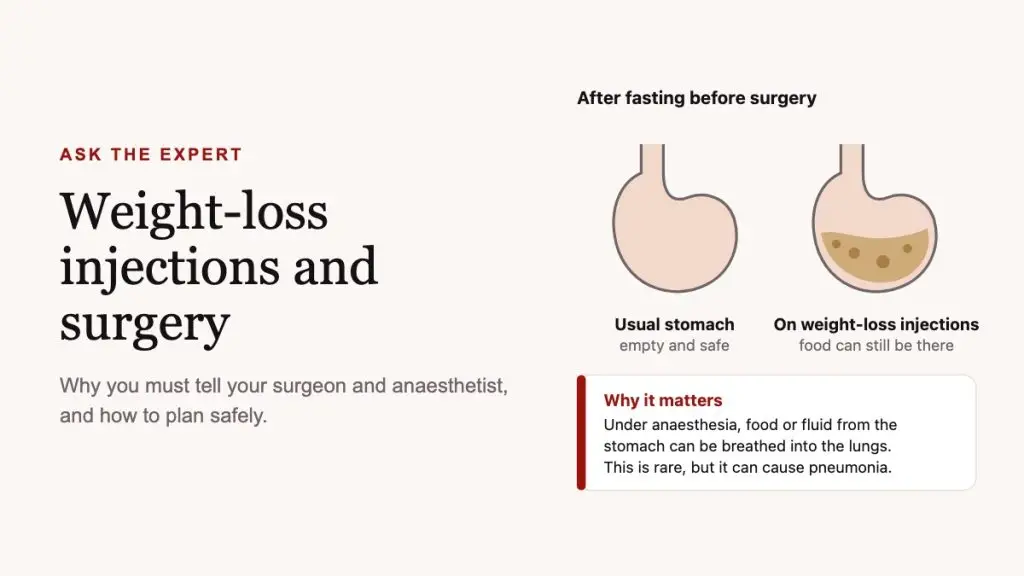
The short answer: if you take a weight-loss or diabetes injection, often called a GLP-1 medicine, you must tell your surgeon and anaesthetist. It’s a prescription medicine, even if you bought it online. These medicines slow down how quickly your stomach empties, so food can still be in your stomach after the usual fasting time, which raises the risk of stomach contents getting into your lungs under anaesthesia. Rapid weight loss can also leave you short of the protein and nutrients your skin needs to heal. For planned cosmetic surgery, I ask my patients to stop their injection four weeks beforehand, agreed with their prescriber. If you have diabetes, your diabetes and anaesthetic team will advise you instead. And there’s a positive side: better blood sugar control and a healthier weight make surgery safer.
When I go through a patient’s medicines before surgery, I now ask a specific question: “Are you taking any weight-loss injections?” It’s surprising how often the answer is yes, after they’ve already told me they take nothing. Many people don’t think of their weekly injection as a “real” medicine, especially if they bought it from an online pharmacy rather than getting it from their GP. But these are powerful medicines, and they matter for both your anaesthetic and your healing. In this article I explain why, what the research shows, what I ask my patients to do, and how to give yourself the best chance of a smooth recovery.
What are GLP-1 medicines?
GLP-1 medicines copy a natural gut hormone called GLP-1, which is released after you eat. They reduce appetite, help you feel full sooner, slow down how quickly your stomach empties, and help the body control blood sugar. Some also act on a second gut hormone, called GIP.
They’re used to treat type 2 diabetes and, increasingly, obesity. Most are given as a weekly injection, though some are daily injections and one is available as a daily tablet. In the UK, they’re prescription-only medicines. You may get them through your GP, a hospital weight management service, or a private online pharmacy, but in every case they’re a prescribed medicine.
“I hear ‘I’m not on any medication, just the jab’ almost every week. The jab is a medication, and it’s one your anaesthetist really needs to know about.”
Mr Siva Kumar, consultant plastic surgeon
Why do I need to tell my surgeon and anaesthetist?
There are two main reasons: your anaesthetic safety, and how well your wounds heal. Your team also needs to know because the medicine affects your blood sugar, your appetite and how much you’ll be able to eat around the time of surgery.
Please mention it even if:
- you bought it online or from a private clinic
- you take a low dose, or only take it some weeks
- you’ve stopped recently
- you’re having a small procedure, or one under sedation
How do weight-loss injections affect anaesthesia?
Before an anaesthetic, you’re asked not to eat for about six hours, so that your stomach is empty. When you’re asleep or heavily sedated, the reflexes that normally protect your airway are switched off. If there’s food or fluid in your stomach, it can come back up and be breathed into the lungs. This is called aspiration. It’s rare, but it can cause a serious chest infection (aspiration pneumonia), and in the worst cases it can be life-threatening.
GLP-1 medicines slow down stomach emptying, which is one of the ways they make you feel full. That means the usual fasting time may not be long enough.
The research so far:
- A 2024 study of people having endoscopies under anaesthesia found food still in the stomach in 19% of those taking GLP-1 medicines, compared with 5% of those who weren’t, despite fasting.
- A 2024 analysis of more than 260,000 patients confirmed that leftover stomach contents are more common in people taking these medicines. It didn’t find a clear increase in aspiration pneumonia overall, but aspiration is rare, and these studies weren’t designed to detect every case.
National guidance varies. The 2025 UK consensus from the Association of Anaesthetists, the Royal College of Anaesthetists, the Centre for Perioperative Care and other UK bodies says that GLP-1 medicines should usually be continued around surgery. It recommends the usual fasting times, an individual assessment of each person’s risk of aspiration and, where appropriate, a quick ultrasound scan of the stomach before the anaesthetic. Guidance published in 2024 by several American specialist societies also says most people can continue, but suggests a liquid-only diet for the 24 hours before surgery for those at higher risk, such as people who have recently started or increased their dose. Your anaesthetist will always make the final decision about your anaesthetic.
Why I ask you to stop four weeks before planned cosmetic surgery
For planned cosmetic surgery, my approach is more cautious. I ask my patients to stop their weight-loss injection four weeks before their operation, agreed with whoever prescribes it. My reasons are:
- The medicine lasts for weeks. Weekly injections stay in the body for several weeks after the last dose, so stopping only a few days beforehand doesn’t fully reverse the effect on the stomach.
- Cosmetic surgery is never urgent. When an operation is planned and optional, I’d rather take every reasonable precaution.
- Your appetite comes back. Over those weeks, many people find they can eat more normally again, which helps them take in the protein and nutrients needed for healing.
- Sickness settles. Nausea, vomiting and constipation, which are common side effects, usually ease off, which makes the anaesthetic and recovery more comfortable.
If you have diabetes, please don’t stop on your own. Stopping suddenly can make your blood sugar rise, which is itself bad for healing and infection risk. Your diabetes team and anaesthetist may prefer you to continue, and we’ll plan it together. The same applies if you take the medicine for any other medical reason.
“Four weeks off the injection is a small pause for most people. It makes the anaesthetic safer and gives your body time to eat properly before it has to heal.”
Mr Siva Kumar
How does rapid weight loss affect healing?
Healing a surgical wound is hard work for the body. It has to build new tissue, mainly collagen, the protein that gives skin its strength. To do that, it needs raw materials and energy.
- Protein provides the amino acids collagen is made from. Too little protein reduces the activity of the cells that make collagen, slows the growth of new blood vessels and weakens the wound.
- Vitamin C is essential for making collagen strong. Without enough, collagen fibres can’t link together properly.
- Zinc is needed for making collagen and protein, and for the immune cells that fight infection.
- Iron helps carry oxygen to healing tissue.
- Energy from food powers the whole process.
Weight-loss injections work by making you eat much less. That’s the point, but it can mean you’re short of protein and nutrients, especially if you’ve lost weight quickly, have been sick, or have eaten very little. Studies also show that a significant part of the weight lost on these medicines is muscle rather than fat, which matters for strength and recovery.
Research in plastic surgery is beginning to reflect this:
- A large US study, published in Plastic and Reconstructive Surgery, matched patients taking GLP-1 medicines with similar patients who weren’t. After a tummy tuck, wound complications occurred in 9.8% of those on GLP-1 medicines, compared with 3.6% of those who weren’t. Breast reduction and removal of an overhanging tummy apron (panniculectomy) showed similar patterns.
- A 2025 review of body contouring surgery concluded that these medicines are reasonably safe around surgery, but may be linked to more wound problems, and advised close monitoring for delayed healing.
These are observational studies, so they can’t prove the medicine itself causes the problems. Rapid weight loss, poor nutrition and the reasons people take the medicine may all play a part. But the message is consistent: good nutrition before surgery matters.
How can I prepare well for surgery?
- Reach a stable weight first. For body surgery, I like your weight to have been stable for three to six months before surgery.
- Eat protein at every meal, such as eggs, fish, chicken, beans, lentils, tofu, Greek yoghurt or milk. Many people losing weight need more protein than they think.
- Eat fruit and vegetables every day for vitamin C.
- Consider a daily multivitamin if your diet is limited, and ask your GP about checking your iron, vitamin B12 and vitamin D levels.
- Keep active, including some strength exercise, to protect your muscle.
- Stop smoking and vaping, which is one of the biggest risks to healing.
Can weight-loss injections make surgery safer?
Yes, and this is important. These medicines aren’t just a risk to manage. For many people, they make surgery safer.
- Better blood sugar control. High blood sugar before surgery raises the risk of wound infection and poor healing. UK guidance suggests that planned surgery may need to be delayed if diabetes is poorly controlled (an HbA1c above 69 mmol/mol). GLP-1 medicines are very effective at bringing blood sugar down.
- A healthier weight. Obesity increases the risk of wound problems, blood clots and anaesthetic complications. Losing weight before surgery lowers all of these, and may make you suitable for surgery that wouldn’t otherwise be safe.
- Other health benefits, such as lower blood pressure and improved sleep apnoea, which both matter for anaesthesia.
So the aim isn’t to avoid these medicines. It’s to plan around them, so you get the benefits without the risks. You can read more in GLP-1 weight loss and the rise in body contouring surgery.
When can I restart after surgery?
Usually once you’re eating and drinking normally and your wounds are healing well, often after one to two weeks, but check with me and your prescriber first. If you’ve been off it for several weeks, your prescriber may restart you on a lower dose to limit sickness.
“Please never feel embarrassed to tell us. We’re not judging you for taking it. We just need to know, so we can keep you safe.”
Mr Siva Kumar
Quick questions
I bought my injection online. Does that count?
Yes. It’s the same medicine, with the same effects, wherever it came from. Please tell your surgeon and anaesthetist.
What if I forget to stop before my operation?
Tell us as soon as you realise, even on the day. Your operation may need to be moved, or your anaesthetist may change how they give your anaesthetic. It’s much better to rearrange than to take a risk.
Do I need to stop before a small procedure under local anaesthetic?
For small procedures under local anaesthetic alone, without sedation, the anaesthetic risk is much lower, as you stay awake and your airway reflexes keep working. Still tell us, and we’ll advise you.
Do I need to stop before anti-wrinkle injections or fillers?
No. These don’t involve an anaesthetic. Just tell your practitioner about all your medicines as usual.
Will I put weight back on in four weeks?
Some people notice their appetite returns, but most gain little in a few weeks. Keep to healthy eating, and you can usually restart after surgery.
Do these medicines affect the contraceptive pill?
Some GLP-1 medicines can make the pill less reliable, especially when starting or increasing the dose, and sickness can affect absorption. Ask your prescriber whether you need extra contraception, particularly around the time of surgery.
Next steps
If you’re taking weight-loss injections and thinking about surgery, such as a tummy tuck or surgery after weight loss, book a consultation at The Ü Clinic in Sevenoaks or Oxted. We’ll plan your timing, your medicine and your nutrition together.
Sources
- El-Boghdadly K, et al. Elective peri-operative management of adults taking glucagon-like peptide-1 receptor agonists, glucose-dependent insulinotropic peptide agonists and sodium-glucose cotransporter-2 inhibitors: a multidisciplinary consensus statement. Anaesthesia 2025. doi:10.1111/anae.16541
- Kindel TL, et al. Multisociety clinical practice guidance for the safe use of glucagon-like peptide-1 receptor agonists in the perioperative period. Surgery for Obesity and Related Diseases 2024.
- Wu F, et al. Association of glucagon-like peptide receptor 1 agonist therapy with the presence of gastric contents in fasting patients undergoing endoscopy under anesthesia care. Canadian Journal of Anesthesia 2024. PubMed 38485835
- Baig, et al. GLP-1 receptor agonists and residual gastric content and aspiration in patients undergoing endoscopy: a systematic review and meta-analysis. Gastrointestinal Endoscopy 2024.
- Impact of GLP-1 agonist on surgical wound complications after plastic and reconstructive surgery: a propensity-matched cohort large database analysis. Plastic and Reconstructive Surgery 2025. PubMed 41364427
- Stechmiller JK. Understanding the role of nutrition and wound healing. Nutrition in Clinical Practice 2010;25:61–8.
- Centre for Perioperative Care. Guideline for perioperative care for people with diabetes mellitus undergoing elective and emergency surgery. 2021. cpoc.org.uk

Mr Siva Kumar Veeramani
MBBS, BMed.Sci (Hons), MRCS, MBA, FRCS (Plast.). Consultant Plastic, Reconstructive & Cosmetic Surgeon practising across London, Kent, Surrey and Sussex. GMC 6114710.
About Mr Siva Kumar →