Treatments / Body / Tummy tuck
Tummy Tuck (Abdominoplasty) in Kent, Surrey, Sussex and London
A flatter, firmer tummy
Tummy tuck (abdominoplasty) with Mr Siva Kumar removes loose skin and fat and repairs separated stomach muscles after pregnancy or weight loss.
Medically reviewed by Mr Siva Kumar Veeramani, Consultant Plastic Surgeon, FRCS (Plast), GMC 6114710 · Last reviewed

At a glance
What is a tummy tuck?
When diet and exercise can’t shift it
Pregnancy and significant weight loss can leave loose, overhanging skin and stretched muscles that no amount of exercise will tighten.
A tummy tuck removes the excess skin and fat from the lower abdomen and, where needed, repairs the separated tummy muscles (diastasis). The belly button is repositioned so it looks natural.
The scar runs low across the abdomen, usually below the bikini line. A tummy tuck is not a weight-loss operation, and results are best when you are close to a stable, healthy weight. If you have lost a lot of weight, read about surgery after weight loss to see how a tummy tuck fits into a wider plan. If an overhanging apron of skin is the main problem, a panniculectomy is a smaller operation that removes it.
A tummy tuck can help with
- Loose or overhanging skin on the lower tummy
- Separated tummy muscles after pregnancy
- Stretch marks below the belly button
- A “pouch” that will not shift with exercise
- Rashes under a skin fold
What it won’t do
- Replace weight loss
- Remove every stretch mark
- Stop weight gain or future pregnancy changing the result
Who is it for?
Is a tummy tuck right for you?
A tummy tuck gives the best and safest result when a few things are in place. These are the criteria Mr Kumar uses at consultation.
What BMI do I need for a tummy tuck?
Ideally a BMI of around 30 or less, at a weight you have held steady for at least six months. The risk of complications such as wound-healing problems and fluid collections rises steadily with BMI, and the result is better the closer you are to your goal weight. If your BMI is higher, Mr Kumar will talk honestly about whether to lose more weight first, or whether a smaller operation to remove an overhanging apron of skin, a panniculectomy, would help you move more comfortably in the meantime.
A tummy tuck is likely to suit you if
- You have loose or overhanging skin on your lower tummy
- Your stomach muscles have separated after pregnancy
- Your weight has been stable for at least six months, close to your goal
- You do not smoke, or will stop six weeks before and after surgery
- Your family is complete, and you stopped breastfeeding at least six months ago
- You are in good general health
It may not be the right time if
- You are still losing weight, or plan to lose a lot more
- You are planning a pregnancy
- You smoke or vape and are not ready to stop
- Your BMI is well above 30
- You had weight-loss surgery less than 12 to 18 months ago
- You are hoping it will help you lose weight
Liposuction may suit you better if
- Your skin is firm and springs back when pinched
- The problem is a stubborn area of fat, not loose skin
- Your stomach muscles have not separated
- You would prefer a smaller operation with tiny scars
Not sure whether you need a mini or a full tummy tuck? See the comparison below.
Improve skin quality too
Stretch marks after a tummy tuck
A tummy tuck removes loose skin and many of the stretch marks below the belly button. Those that remain can be improved with radiofrequency microneedling or CO₂ laser, usually starting a few months after surgery.
How surgery and skin treatments fit together · Stretch mark treatment
Revision or complex case?
When previous surgery needs putting right
If you are unhappy with the result of previous surgery, in the UK or abroad, Mr Kumar offers revision surgery for selected complex cases, drawing on his reconstructive experience.
Options
The right tummy tuck for you
Full abdominoplasty
Removes loose skin above and below the belly button, repairs the muscles and repositions the belly button.
- Best for: loose skin and muscle separation
Mini abdominoplasty
A shorter scar treating only the skin below the belly button.
- Best for: a small pouch of skin below the belly button
- Mini tummy tuck
Fleur-de-lis abdominoplasty
Adds a vertical scar to tighten the waist as well, for large amounts of loose skin.
- Best for: after massive weight loss
- Fleur-de-lis tummy tuck
Mini or full?
Mini vs full tummy tuck: which do I need?
The difference comes down to where your loose skin is and what your muscles are doing, not how big an operation you would like. Choosing a mini for the wrong tummy is one of the commonest reasons people are disappointed with their result.
| Mini tummy tuck | Full tummy tuck | |
|---|---|---|
| Area treated | Below the belly button only | Above and below the belly button |
| Scar | Shorter, low on the tummy | Hip to hip, usually below the bikini line, plus a small scar around the belly button |
| Belly button | Usually left alone | Repositioned so it looks natural |
| Muscle repair | Below the belly button only, if at all | The full length of separated muscles |
| Best for | A small pouch of skin low down, with firm skin above and intact muscles | Loose skin above and below the belly button, separated muscles, or after pregnancy or weight loss |
| Back to desk work | Often one to two weeks | Usually two to three weeks |
| Guide price | From £4,500 | From £9,500 |
A quick check at home: stand side-on to a mirror and lean forward slightly. If loose skin hangs above your belly button as well as below it, or you see a ridge or bulge down the middle of your tummy when you lift your head while lying down, a full tummy tuck is more likely to give you the shape you want.
Mr Kumar’s full guide: how to tell which you need, the scars, recovery, and why a mini tummy tuck is often not enough.
Read: mini vs full tummy tuckAfter weight loss
After Mounjaro, Wegovy or weight-loss surgery
More and more people come to see Mr Kumar after losing weight with weight-loss injections such as Mounjaro, Wegovy or Ozempic, or after a gastric bypass or sleeve. A tummy tuck can remove the loose, overhanging skin left behind, but timing and preparation matter.
When to have it
- When your weight has been stable for at least six months, ideally close to your goal
- Usually 12 to 18 months after weight-loss surgery
- On injections: once you are stable on a maintenance dose, or stable after stopping, as many people regain weight when they stop
Your medication
Weight-loss injections slow the emptying of the stomach, which matters for the anaesthetic. Tell Mr Kumar and your anaesthetist that you take one, and do not stop or change it without speaking to your prescriber, in line with MHRA safety advice.
The operation
After larger weight loss, loose skin often wraps around the hips, so an extended or fleur-de-lis tummy tuck, or a lower body lift, may be better. Blood tests beforehand check iron, vitamin B12, vitamin D and protein, which you need to heal well.
Read more: what surgery can do for loose skin after weight-loss injections, and how to prepare.
Loose skin after Mounjaro or WegovyYou can see every option on the surgery after weight loss page.
Watch & read
Everything you need to know, in one place
Patient guide
Tummy tuck: your patient guide
A detailed booklet written by Mr Kumar. It explains the procedure in depth, how to prepare, every risk and complication, and how to look after yourself afterwards.
Opens as a booklet you can flick through. Your copy is also given to you at consultation.
Your journey
Your step-by-step journey
Your journey starts the moment you get in touch. From your first enquiry to your final check-up, you deal with the same small team, and you will always feel listened to, informed and never rushed.
Get in touch
Call, email or send an enquiry. Our team replies promptly and personally, and finds a time and clinic that suit you.
There is no pressure and no sales script. Tell us a little about what prompted you to get in touch, and we will make sure your consultation is with the right person for you.
Consultation
An unhurried, face-to-face appointment with Mr Kumar himself, who will be your surgeon from start to finish.
He listens to what you would like to change, examines you, explains every option, including non-surgical ones and doing nothing, and gives you an honest view of the likely result.
Time to decide
You receive a written plan, a clear quote and your patient guide, then take as long as you need.
A second consultation is included before surgery, and there is a cooling-off period of at least two weeks. Bring someone with you, ask anything, and change your mind at any point.
Day of treatment
Surgery takes about three hours under general anaesthetic, and you stay one night. You wake up in a compression garment, sometimes with small drains.
He will see you beforehand to go through the plan and answer last-minute questions, and you will have clear instructions and a number to call once you go home.
Aftercare and follow-up
Reviews at each stage of your recovery, with support 24 hours a day whenever you need it.
Follow-up appointments are included in your package price, and continue until you have healed and are happy with how things have settled. You wear your compression garment for around six weeks.
Recovery
Healing, step by step
Everyone heals at their own pace. This is a typical recovery, and Mr Kumar will give you a personal plan.
Walk slightly bent at first. Drains, if used, are usually removed before you go home.
Short walks. Shower after two days. Wear your garment day and night.
Most people return to desk work and driving.
Return to exercise and lifting, building up gradually.
Swelling settles and the scar fades and flattens.
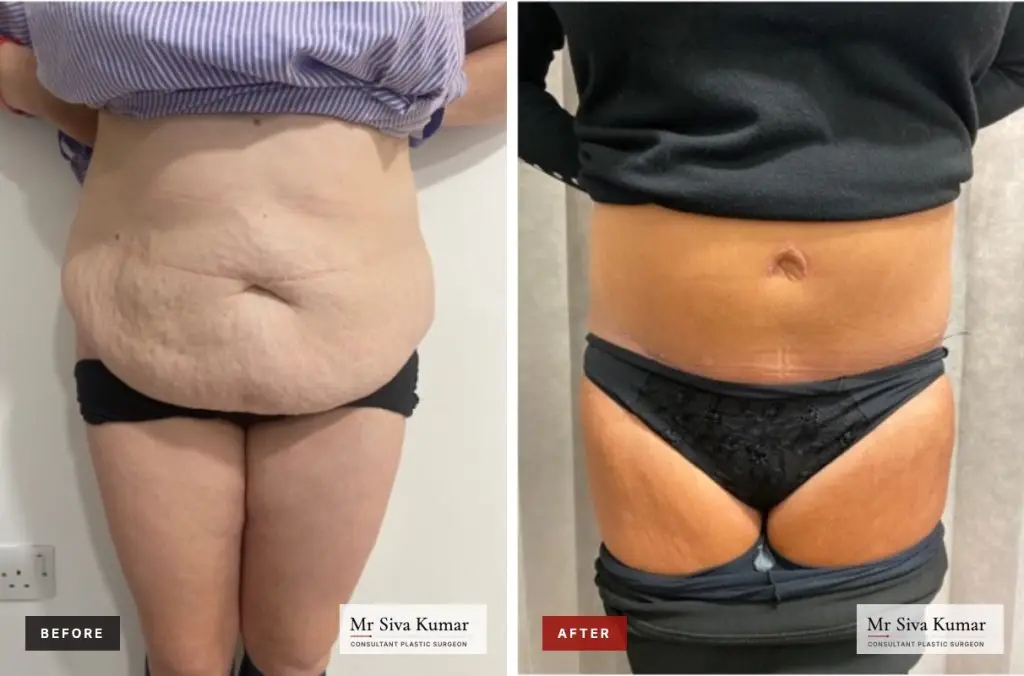
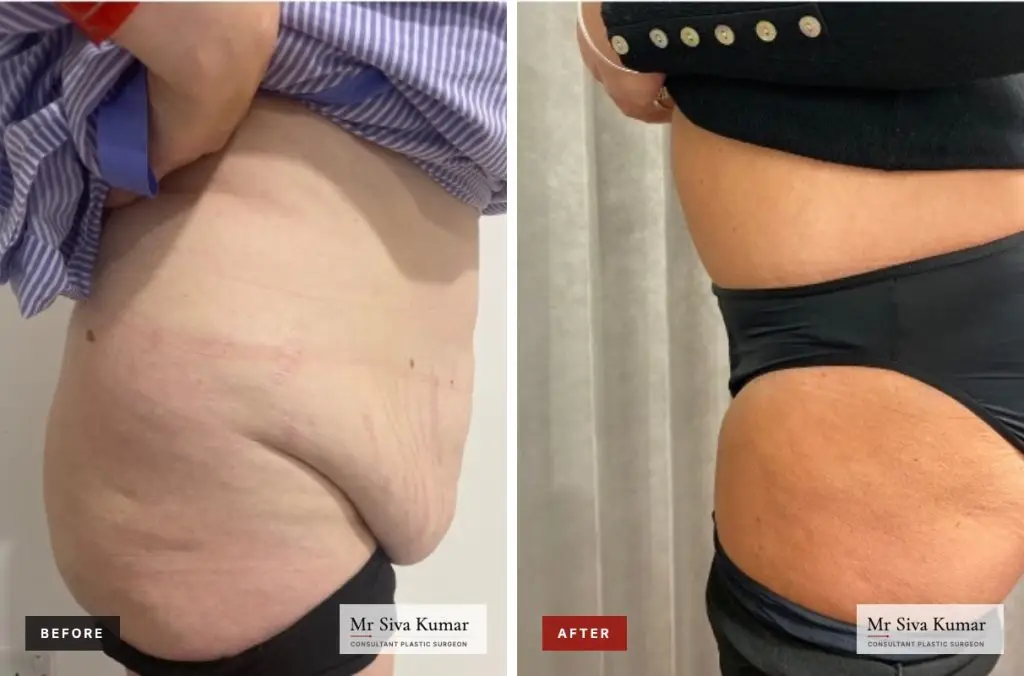
Patient results
Before & after
Photographs are shared only with each patient’s written consent. Everyone is different, so individual results vary.
Patient reviews
In their own words
194 verified reviews on Doctify
90 verified reviews on Top Doctors
90 reviews on Top Doctors
Can highly recommend Mr Kumar. Made me feel very comfortable with what was a pretty major surgery - very professional and it looks like I will get a great result. A big thank you!
I am absolutely thrilled with my body, and it's all thanks to the incredible expertise of Mr. Kumar. I'm struggling to find the right words to express my gratitude for him, the preoperative and post-surgery process, and the entire team at The McIndoe hospital. …
My Abdominoplasty by Dr Kumar gave me back my confidence. Brilliant pre- and post-op care. Highly qualified surgeon.
Safety
Risks and staying safe
All surgery carries some risk. Mr Kumar will go through these with you in detail, and the patient guide covers them in full, so you can make an informed decision.
Possible risks
- Fluid collection (seroma)
- Bleeding or haematoma
- Infection or wound-healing problems
- Numbness of the lower tummy
- Visible or thickened scarring
- Asymmetry or “dog ears” at the scar ends
- Blood clots (DVT or PE)
- Anaesthetic risks
Lowering your risk
- Stop smoking at least six weeks before and after surgery, as it greatly increases wound problems
- Aim for a stable weight before surgery
- Tell us about all medicines and supplements, especially blood thinners
- Stop smoking and vaping well before and after surgery
- Follow your aftercare plan and attend every follow-up
- Call us at any time if something does not feel right
Fees
Guide price from£4,500
- Mini tummy tuck£4,500
- Full tummy tuck£9,500
Self-pay consultations £250.
One package price. No hidden surprises.
If you go ahead, you receive a single package price covering your whole journey, so you know exactly what you are paying before you commit. It usually includes:
- Your surgeon’s fee
- Anaesthetist’s fee
- Hospital and theatre fees
- Follow-up consultations
- Aftercare, with 24/7 support
- A clear written quote
FAQs
Your questions, answered
Can I get pregnant after a tummy tuck?
Yes. A tummy tuck does not affect your ability to get pregnant or carry a baby safely, but pregnancy will stretch the skin and muscles again and can undo much of the result. It is usually best to wait until your family is complete, and until about six months after you have stopped breastfeeding.
Is there an upper age limit for a tummy tuck?
There is no fixed upper age limit: your general health matters far more than your age. Fit, healthy people in their sixties and seventies can have a tummy tuck safely. Mr Kumar will check your heart and lung health, your medicines and your risk of blood clots, and may ask for tests or a letter from your GP.
Will my belly button look natural?
Yes. In a full tummy tuck your own belly button is kept and brought out through the tightened skin in a natural position, with a small scar hidden around its rim, and it is shaped to look natural rather than stretched or round. In a mini tummy tuck it is usually left alone.
Will I lose weight, and what if I gain weight afterwards?
A tummy tuck is not a weight-loss operation: the skin and fat removed usually weigh only a little, but the change in shape can be dramatic. Small changes in weight make little difference afterwards, but significant weight gain will stretch the tummy again. The result lasts best at a stable weight.
Can it be combined with liposuction, a hernia repair or breast surgery?
Often, yes. Liposuction of the waist or flanks is commonly added for a smoother shape, and a tummy tuck can be combined with breast surgery as a mummy makeover. A small hernia at the belly button can often be repaired at the same time, while larger hernias may need a general surgeon. Combining procedures makes the operation longer, so Mr Kumar will advise whether it is safe for you.
Is a tummy tuck the same as liposuction?
No. Liposuction removes fat through tiny incisions but does not remove loose skin or repair muscles. A tummy tuck removes loose skin and fat and repairs separated muscles. If your skin is firm and the problem is fat alone, liposuction may suit you better.
How painful is a tummy tuck?
Most people describe it as tight and sore rather than very painful, especially for the first few days. It is more uncomfortable if your muscles are repaired, because those stitches work every time you move or cough. Regular painkillers keep it under control, and most people need only simple painkillers after the first week.
Will I need drains?
Not always. Small drains are sometimes used for a day or so to let fluid out of the wound, and if they are, they are usually removed before you go home. Mr Kumar will tell you beforehand whether to expect them.
When can I fly after a tummy tuck?
Short flights may be possible after a couple of weeks, but long-haul flights are best avoided for about six weeks, because both abdominal surgery and long flights increase the risk of blood clots. Please check with Mr Kumar before you book.
How long will I walk and sleep bent over?
Usually for the first one to two weeks. Your tightened skin pulls when you stand fully upright, so you walk slightly bent at the waist and sleep with your head and knees raised. You straighten a little more each day, and most people are standing fully upright by about two weeks.
When can I exercise after a tummy tuck?
Gentle walking from the first day. Most people return to the gym and lifting from about six weeks, building up gradually. If your muscles were repaired, avoid sit-ups, planks and heavy core work until about three months. See tummy tuck recovery week by week.
Where will the scar be?
Low across the tummy, usually from hip to hip and hidden by underwear or a bikini, plus a small scar around the belly button. It is planned with you before surgery, and it fades and flattens over 12 to 18 months.
I have a Caesarean scar. What happens to it?
In a full tummy tuck your Caesarean scar is usually removed, because it sits within the skin that is taken away. The new scar sits in a similar low position but runs further towards the hips. A mini tummy tuck can also remove an overhanging Caesarean “shelf” and the old scar with it.
How do I choose a tummy tuck surgeon?
Choose a surgeon on the GMC Specialist Register for plastic surgery, meet the surgeon who will actually operate, check the hospital is registered with the CQC, and make sure you know exactly who looks after you afterwards. The same checks apply to any cosmetic operation: see how to choose a cosmetic surgeon.
Can I have a tummy tuck on the NHS or through insurance?
Rarely. A tummy tuck for appearance is self-pay. The NHS funds it only under strict local criteria, usually after major weight loss, with a stable BMI held for a year or more and documented problems such as recurrent skin infections. Private insurers rarely cover it.
Tummy tuck: what is the guide price?
The guide price starts from £4,500. Your final fee depends on your treatment plan and choice of hospital, and is confirmed in a written quote after consultation. Self-pay consultations cost £250.
Ask the expert
Questions answered
Longer answers from Mr Kumar to questions patients often ask about this treatment.
Tummy tuck recovery week by week
What tummy tuck recovery really feels like, from the first night in hospital to the final scar: pain, the garment, work, driving, exercise and the essentials to have ready.
Read the answer →
Mini vs full tummy tuck: which do I need?
The real difference between a mini and a full tummy tuck: the scar, muscle repair, the belly button, recovery and cost, who suits each, and why the smaller operation can disappoint.
Read the answer →
How do I get the best possible scar after surgery?
A surgeon’s simple scar care routine: when to start massage and moisturising, silicone gel or sheets, sun protection, and how IPL and CO2 laser can help after surgery.
Read the answer →
Locations
Where to have your tummy tuck in Kent, Surrey and Sussex
Your consultation and follow-up appointments with Mr Siva Kumar are at The Ü Clinic in Sevenoaks, Kent, or The Ü Clinic in Oxted, Surrey. Your surgery takes place at one of his partner hospitals: The McIndoe Centre in East Grinstead, West Sussex, KIMS Hospital in Maidstone, or North Downs Hospital in Caterham. See all of Mr Siva Kumar's clinic and hospital locations.
Both clinics are within easy reach of Tunbridge Wells, Tonbridge, West Malling, Westerham, Swanley, Dartford, Gravesend, Orpington, Bromley, Redhill, Reigate, Caterham, Coulsdon, Purley and Croydon. KIMS Hospital in Maidstone is close to Rochester, Chatham, Gillingham, Aylesford and Ashford, and The McIndoe Centre in East Grinstead is close to Crawley, Horley, Haywards Heath and Edenbridge. Patients also travel from across Sussex, including Brighton, Worthing, Horsham, Eastbourne, Hastings and Crowborough.
Tummy tuck cost: guide prices start from £4,500. Your fee is confirmed in a written quote after your consultation. Read the full tummy tuck cost guide.
Thinking about a tummy tuck?
Start with an unhurried consultation with Mr Siva Kumar at The Ü Clinic in Sevenoaks or Oxted. Self-pay consultations cost £250.