Treatments / Face / Upper eyelid surgery
Upper Eyelid Surgery (Blepharoplasty) in Kent, Surrey, Sussex and London
Hooded or heavy upper eyelids?
Upper blepharoplasty with Mr Siva Kumar removes the excess skin, often while you are awake, and you go home the same day. Your eyes look more open and rested, with the scar hidden in the natural crease.
Medically reviewed by Mr Siva Kumar Veeramani, Consultant Plastic Surgeon, FRCS (Plast), GMC 6114710 · Last reviewed
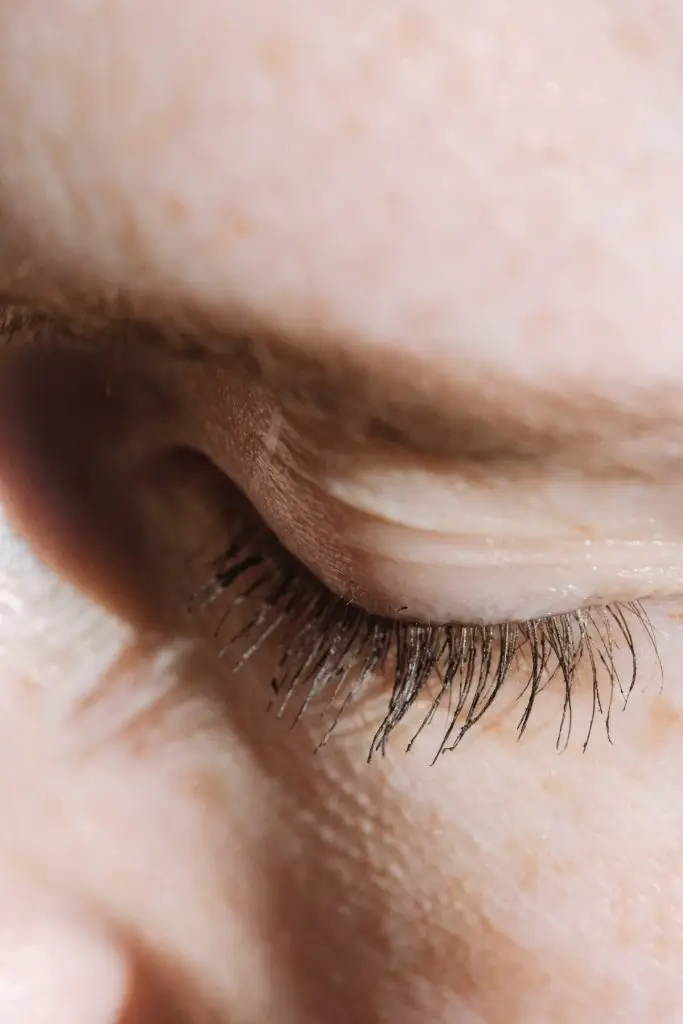
At a glance
What is upper eyelid surgery?
Removing the hood, keeping your look
Your eyes are the first thing people notice. With age, the skin of the upper eyelids stretches and folds over the lashes, making the eyes look heavy or tired, and sometimes getting in the way of your vision.
Upper blepharoplasty removes this excess skin, and a little fat where needed. The scar sits in the natural crease of the eyelid, so it is well hidden once healed.
The operation can be done with the eyelids numbed while you are awake, or under general anaesthetic. You go home the same day.
Upper eyelid surgery can help with
- Heavy, hooded upper eyelids
- Skin resting on the lashes or blocking your vision
- Eyes that look tired, especially on video calls
- Eye make-up that smudges or is hard to apply
- Soreness in the fold of the eyelid
What it won’t do
- Lift a low brow (this needs a brow lift)
- Remove dark circles or crow’s feet
- Treat bags under the eyes (lower eyelid surgery)
Suitability
Is upper eyelid surgery right for you?
Upper blepharoplasty works best when the heaviness really is excess eyelid skin. Before you book, it is worth knowing who it suits, and when something else may help more.
You may be a good candidate if
- Excess skin on your upper eyelids folds onto or near your lashes
- Your eyes look heavy or tired, even when you are rested
- Your brows sit in a reasonable position, or you are happy for them to be assessed too
- You are in good general health
- You do not smoke, or are willing to stop around the time of surgery
- You want a fresher, more open look, not differently shaped eyes
It may not be the right choice yet if
- A low brow is the main cause, when a brow lift may help more
- The edge of the eyelid itself droops (ptosis), which needs a different operation
- You have untreated dry eye or active thyroid eye disease
- You have had eye surgery, including laser eye surgery, in the last few months
- You have uncontrolled high blood pressure or a bleeding disorder
- You are hoping to remove crow’s feet, dark circles or bags under the eyes
Not sure which applies to you? Try the one-minute self-check below.
Self-check
Hooded eyes? Find out what is causing them
Six quick questions, including the two simple mirror tests used at consultation. You get an instant, honest suggestion of where the heaviness is coming from and what is likely to help. It takes about a minute, and nothing you choose is stored or sent anywhere.
Question 1 of 6
A guide only, not a diagnosis, and it cannot replace an examination. Nothing you choose is stored or sent anywhere.
Improve skin quality too
Eyelid surgery and CO₂ laser, together
Mr Kumar is one of the few surgeons in the UK who combine eyelid surgery with CO₂ laser and carry out both himself. Surgery removes the hooding; fractional CO₂ laser smooths crepey skin and fine lines around the eyes, often at the same operation.
Options
Surgery or a mini-bleph
Upper blepharoplasty removes excess skin surgically. For earlier changes, a mini-bleph tightens the eyelid skin with CO2 laser, without surgery.
Upper blepharoplasty
Excess skin, and a little fat where needed, is removed through an incision in the natural crease of the eyelid.
- Best for: moderate to marked hooding of the upper eyelids
Mini-bleph (Madonna eyelift)
Fractional CO2 laser tightens and smooths the eyelid skin without any cutting or stitches. It is done under numbing cream with your eyes protected, and you can expect around a week of swelling, redness and peeling.
- Best for: earlier changes in younger people, a more modest change, or maintenance after previous eyelid surgery
- Read about the mini-bleph
Brow lift or blepharoplasty?
Hooded eyelids or a low brow?
Heavy upper eyelids are not always caused by the eyelids. As the forehead ages, the eyebrows can drop and push skin down onto the lids, which looks very similar. Treating the wrong one is one of the commonest reasons for a disappointing result: removing eyelid skin beneath a low brow can pull the brow down further and make the eyes look heavier, not lighter.
The finger test
Stand in front of a mirror in good light, relax your forehead and look straight ahead. Place a fingertip at the outer end of one eyebrow and lift it gently by about half a centimetre, to roughly where it sat in photos from ten years ago. Then look at the heaviness over your eyelid.
Your brow is the main cause
A brow lift is likely to help more than eyelid surgery on its own.
Both are contributing
The brow is assessed first, and only the skin that remains is removed, so the eyes still close comfortably.
Excess eyelid skin
Upper blepharoplasty is likely to help.
The test is a guide, not a diagnosis. Many people over 50 have a little of both, and brow and eyelid surgery can be done together. Mr Kumar will examine your brow position, eyelid skin and eye closure, and tell you honestly which you need and why. You can also try the self-check.
Hooded eyes or ptosis?
Excess skin or a drooping lid?
Two different problems can make the upper eyelids look heavy, and they need different operations. Hooded eyes, which doctors call dermatochalasis, are caused by excess skin folding over the eyelid. Ptosis is when the eyelid itself sits too low, because the muscle that lifts it has stretched or weakened.
Hooded eyelids
- A fold of skin hangs over the crease, sometimes onto the lashes
- The edge of the eyelid sits in its usual place, just over the top of the coloured part of the eye
- Usually affects both sides similarly
- Treated with upper blepharoplasty
Ptosis (a drooping eyelid)
- The edge of the eyelid covers more of the coloured part of the eye, sometimes the pupil
- The crease may sit high, and the lid can look hollow
- One side is often lower than the other
- Common with age, long-term contact lens wear or after eye surgery
- Treated with ptosis repair, which tightens the lifting muscle
The two often occur together, and upper blepharoplasty will not lift a drooping eyelid. That is why Mr Kumar measures the height of the eyelid edge and the strength of the lifting muscle at every consultation. If ptosis is part of the picture, he will explain your options, including referral to a colleague where that is the right choice.
Functional or cosmetic?
When hooded eyelids affect your vision
The operation is the same, but the reason for it can be different, and that matters for funding.
| Functional blepharoplasty | Cosmetic blepharoplasty | |
|---|---|---|
| Main reason | Excess skin gets in the way: it blocks the top or sides of your vision, makes you raise your brows all day to see, or makes the fold sore | The appearance: eyes that look heavy, tired or older than you feel |
| How it is assessed | Examination, photographs and usually a visual field test, often repeated with the eyelids gently taped up to show how much vision improves | Examination and photographs |
| Funding | Some private insurers will consider it. The NHS funds it only under strict local criteria | Self-pay |
| What it achieves | A wider field of vision and less brow strain, as well as a fresher look | A fresher, more open, rested look |
Many people’s reasons are a mix of both. If you think your vision is affected, mention it when you book, and check your policy before your consultation. Insurers will need Mr Kumar’s full name, Siva Kumar Veeramani, and GMC number 6114710.
Watch & read
Everything you need to know, in one place
Patient guide
Upper eyelid surgery: your patient guide
A detailed booklet written by Mr Kumar. It explains the procedure in depth, how to prepare, every risk and complication, and how to look after yourself afterwards.
Opens as a booklet you can flick through. Your copy is also given to you at consultation.
Videos
Mr Kumar explains
Your journey
Your step-by-step journey
Your journey starts the moment you get in touch. From your first enquiry to your final check-up, you deal with the same small team, and you will always feel listened to, informed and never rushed.
Get in touch
Call, email or send an enquiry. Our team replies promptly and personally, and finds a time and clinic that suit you.
There is no pressure and no sales script. Tell us a little about what prompted you to get in touch, and we will make sure your consultation is with the right person for you.
Consultation
An unhurried, face-to-face appointment with Mr Kumar himself, who will be your surgeon from start to finish.
He listens to what you would like to change, examines you, explains every option, including non-surgical ones and doing nothing, and gives you an honest view of the likely result.
Time to decide
You receive a written plan, a clear quote and your patient guide, then take as long as you need.
A second consultation is included before surgery, and there is a cooling-off period of at least two weeks. Bring someone with you, ask anything, and change your mind at any point.
Day of treatment
The operation takes about an hour, under local or general anaesthetic. You go home the same day with cold compresses and clear instructions.
He will see you beforehand to go through the plan and answer last-minute questions, and you will have clear instructions and a number to call once you go home.
Aftercare and follow-up
Reviews at each stage of your recovery, with support 24 hours a day whenever you need it.
Follow-up appointments are included in your package price, and continue until you have healed and are happy with how things have settled. Your stitches are removed after seven days.
The operation
Upper blepharoplasty, step by step
From arriving to going home usually takes a few hours. The operation itself takes about an hour for both eyes.
Arrival and checks
You meet the team, go through your consent form and ask any last questions. Please come without eye make-up or contact lenses.
Marking
With you sitting up, Mr Kumar marks your natural crease and the exact amount of skin to remove, measuring both sides so they match and leaving enough skin for your eyes to close comfortably.
Anaesthetic
The eyelids are numbed with fine injections of local anaesthetic, which sting for a few seconds. If you are having a general anaesthetic, you are asleep before this.
Removing the excess
A measured strip of skin is removed along the marked line, with a thin strip of muscle or a little fat if it is adding to the heaviness. If you are awake, you may feel gentle pressure but no pain.
Closing
The wound is closed with a very fine stitch that sits in the crease, and the same is done on the other side.
Cold compresses
Cold compresses go on straight away to reduce swelling, and you rest for a while with your head raised.
Going home
You go home the same day with eye drops or ointment, pain relief and written aftercare. Someone needs to drive you home.
Stitches out
About seven days later the stitch is removed. Most people return to work and driving at around this point.
Recovery
Upper eyelid surgery recovery, step by step
Everyone heals at their own pace. This is a typical recovery, and Mr Kumar will give you a personal plan.
Go home the same day. Use cold compresses and rest with your head raised.
Swelling and bruising are at their most noticeable. Keep the wounds clean.
Stitches out. Most bruising has settled and most people return to work and driving.
Return to exercise and make-up. The eyes look increasingly natural.
The scar fades to a fine line in the crease.
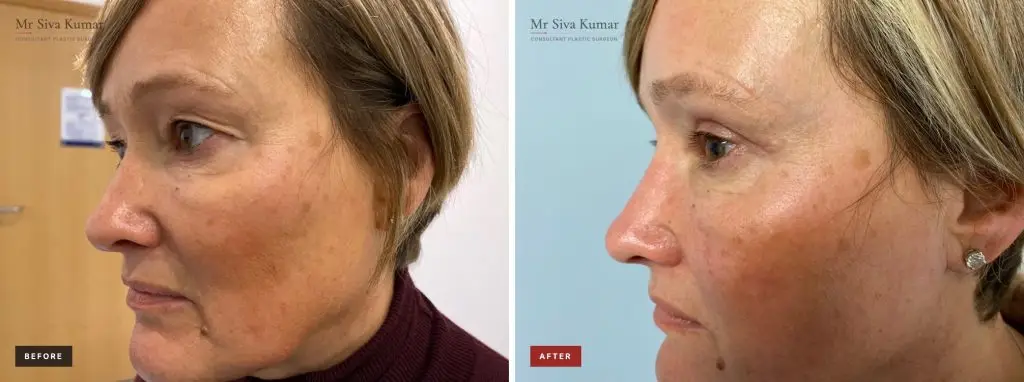
Patient results
Upper eyelid surgery before & after
Photographs are shared only with each patient’s written consent. Everyone is different, so individual results vary.
Patient reviews
In their own words
194 verified reviews on Doctify
90 verified reviews on Top Doctors
90 reviews on Top Doctors
From the initial consultation, Dr Kumar could not have been any more reassuring and informative. He gave me every confidence that he was the very best choice of surgeon for my proceedure. I am extremley pleased with the results and would absolutely recommend!
Mr Siva Kumar won my trust from the very first consultation. In each and every meeting I had prior to surgery and post surgery he has talked me through exactly what would be happening both clearly and concisely. There were no questions in my mind and no hesitation in proceeding with my surgery. …
Mr Kumar explained the procedure fully and what I could expect the outcome would be -,he also suggested I went away and thought about what we had discussed so I could be sure I still wanted to go ahead -he put me at ease during the operation even making a little joke -I would not hesitate recommending him
Safety
Upper eyelid surgery risks and staying safe
All surgery carries some risk. Mr Kumar will go through these with you in detail, and the patient guide covers them in full, so you can make an informed decision.
Possible risks
- Bruising and swelling
- Dry, gritty or watery eyes for a while
- Infection or bleeding
- Asymmetry
- Visible scarring (rare in the eyelid crease)
- Difficulty closing the eyes fully (usually temporary)
- Very rarely, problems with vision
Lowering your risk
- Tell us about all medicines and supplements, especially blood thinners
- Stop smoking and vaping well before and after surgery
- Follow your aftercare plan and attend every follow-up
- Call us at any time if something does not feel right
Fees
Guide price from£3,500
Self-pay consultations £250.
Upper eyelid surgery cost: one package price, no hidden surprises.
If you go ahead, you receive a single package price covering your whole journey, so you know exactly what you are paying before you commit. It usually includes:
- Your surgeon’s fee
- Anaesthetist’s fee
- Hospital and theatre fees
- Follow-up consultations
- Aftercare, with 24/7 support
- A clear written quote
FAQs
Your upper eyelid surgery questions, answered
Will the scar be visible?
Once healed, the scar is usually very hard to see. It sits in the natural crease of the upper eyelid, so it is hidden when your eyes are open, and it fades to a fine line over three to six months. If it extends slightly into a laughter line at the outer corner, that part can take a little longer to fade.
Is it painful? Will I be awake?
Most people find it uncomfortable rather than painful. Most upper eyelid surgery is done awake under local anaesthetic, so the eyelids are numb and you feel pressure but no pain, and a general anaesthetic is available if you prefer. Afterwards the eyes feel tight, dry and bruised for a few days, and simple painkillers such as paracetamol are usually enough.
Does upper blepharoplasty fix drooping eyelids (ptosis)?
No. Upper blepharoplasty removes excess skin, but ptosis is a drooping of the eyelid itself, caused by a stretched or weakened lifting muscle, and it needs a different operation called ptosis repair. The two can occur together, which is why Mr Kumar checks the height of the eyelid edge at every consultation.
What is the difference between hooded eyes and a low brow? Do I need a brow lift?
Hooded eyes are caused by excess skin on the eyelid itself, while a low brow pushes skin down from above. Lift your eyebrow gently with a fingertip in a mirror: if most of the heaviness disappears, your brow is a big part of the problem and a brow lift may help; if a fold remains, you have excess eyelid skin that blepharoplasty treats. Many people have a little of both, and eyelid surgery can also be combined with lower eyelid surgery or a facelift.
Does it change how the eyes look in men?
It should not make a man’s eyes look feminine. Men usually have a lower, flatter eyelid crease and a heavier, straighter brow, so skin is removed more conservatively and the crease is kept low, giving a fresher look that still looks natural for a man. The scar is just as well hidden.
Can I read or use my phone afterwards?
Yes, in short bursts from the first day. Your eyes may feel dry, look slightly blurry from ointment and tire quickly for the first few days, so take frequent breaks, use lubricating drops, and save long spells of reading or screen work until the swelling settles, usually after the first week.
Will I be able to close my eyes?
Yes. For the first few days you may not close your eyes completely, especially while asleep, because of swelling, and lubricating ointment at night protects the eyes in the meantime. This usually settles within days to a few weeks. The skin is measured carefully so that enough is left for the eyelids to close normally.
What is the best age for upper eyelid surgery?
There is no best age: it depends on how much excess skin you have, not how old you are. Most people are in their 40s to 70s, but hooding runs in families and some people benefit in their 30s. Good general health and realistic expectations matter more than age.
How should I sleep after upper blepharoplasty?
Sleep on your back with your head raised on two or three pillows for about a week. This helps the swelling settle faster and stops you rubbing your eyes on the pillow. Avoid sleeping on your side or front until you are told it is fine, usually after the first week.
How do I prepare for upper eyelid surgery?
Stop smoking and vaping at least six weeks before, and tell Mr Kumar about all your medicines and supplements, especially blood thinners, but do not stop prescribed medicines on your own. Arrange a lift home and someone to stay with you the first night, plan about a week off work, and have cold compresses, lubricating eye drops and sunglasses ready. Come without eye make-up or contact lenses on the day.
Should I have a mini-bleph or an upper blepharoplasty?
It depends on how much excess skin there is. Mild hooding and crepey eyelid skin often respond well to a mini-bleph, while moderate to marked hooding, or heavy upper lids that rest on the lashes, need surgery to remove the skin. Mr Kumar will examine your eyelids and advise which is most likely to give you the result you want.
Is upper blepharoplasty worth it?
For the right person, yes: it is one of the most satisfying operations in cosmetic surgery, with a short recovery and results that last for many years, often ten or more. The skin that is removed does not come back, although natural ageing continues. The key is making sure the problem really is excess eyelid skin rather than a low brow or a drooping lid, which is exactly what the consultation is for.
Why choose a plastic surgeon rather than an ophthalmologist?
Both can be excellent choices: what matters most is a surgeon who performs eyelid surgery regularly. Ophthalmologists who specialise in eyelids, called oculoplastic surgeons, are experts in the eye and its surroundings and are often the right choice for complex ptosis or eye conditions. A consultant plastic surgeon brings training across the whole face, skin and scars, so your eyelids can be planned alongside your brow, cheeks and lower face, and combined with procedures such as a facelift or fat grafting if needed. Mr Kumar also trained in oculoplastic surgery as part of his cosmetic surgery fellowship, so he brings both perspectives.
Is it available on insurance or the NHS?
Sometimes, if it is functional rather than cosmetic. If the excess skin significantly blocks your vision, some insurers will consider surgery, usually after a formal visual field test, and some NHS areas fund it under strict criteria. Surgery purely for appearance is self-pay. Insurers will need Mr Kumar’s full name, Siva Kumar Veeramani, and GMC number 6114710.
Upper eyelid surgery: what is the guide price?
The guide price starts from £3,500. Your final fee depends on your treatment plan and choice of hospital, and is confirmed in a written quote after consultation. Self-pay consultations cost £250.
Ask the expert
Questions answered
Longer answers from Mr Kumar to questions patients often ask about this treatment.
How long does an upper blepharoplasty take?
Upper eyelid surgery by the clock: how long the operation and your day take, a week-by-week healing timeline, when you can drive, work, fly and exercise, how far ahead to plan for an event, and how long results last.
Read the answer →
Upper eyelid surgery (upper blepharoplasty): what to expect
Heavy, hooded eyelids? A consultant plastic surgeon explains upper blepharoplasty: who it suits, the day of surgery, recovery day by day, scars, risks, results, cost and NHS or insurance funding.
Read the answer →
Blepharoplasty scars: will people be able to tell?
Where eyelid surgery scars sit, how they heal week by week, the best way to look after them, and how visible blepharoplasty scars really are once they have settled.
Read the answer →
Eyelid surgery and CO₂ laser together: is it worth it?
Upper eyelid surgery with CO₂ laser: why combine them, same operation or separate, who suits it, recovery and cost, from a surgeon who does both.
Read the answer →
Why I combine surgery with laser and skin treatments
Why a consultant plastic surgeon plans surgery and skin treatments together: structure and skin, the right order, and when not to combine.
Read the answer →
Locations
Where to have your upper eyelid surgery in Kent, Surrey and Sussex
Your consultation and follow-up appointments with Mr Siva Kumar are at The Ü Clinic in Sevenoaks, Kent, The Ü Clinic in Oxted, Surrey, or his weekly clinic at KIMS Hospital in Maidstone. Your surgery takes place at one of his partner hospitals: The McIndoe Centre in East Grinstead, West Sussex, KIMS Hospital in Maidstone, or North Downs Hospital in Caterham. See all of Mr Siva Kumar's clinic and hospital locations.
The Ü Clinics in Sevenoaks and Oxted are within easy reach of Tunbridge Wells, Tonbridge, West Malling, Westerham, Swanley, Dartford, Gravesend, Redhill, Reigate and Caterham. KIMS Hospital in Maidstone, just off junction 7 of the M20, is close to West Malling, Kings Hill, Aylesford, Rochester, Chatham and Gillingham, and easy to reach from Sittingbourne and the Isle of Sheppey on the A249, from Ashford on the M20, and from Canterbury and Faversham via the M2. The McIndoe Centre in East Grinstead is close to Crawley, Horley, Haywards Heath and Edenbridge. Patients also travel from across Sussex, including Brighton, Worthing, Horsham, Eastbourne, Hastings and Crowborough. Many patients also come from London: both clinics are a short drive from Bromley, Croydon, Orpington, Purley and Coulsdon, and Sevenoaks and Oxted have direct trains to central London.
Upper eyelid surgery cost: guide prices start from £3,500. Your fee is confirmed in a written quote after your consultation. Read the full upper eyelid surgery cost guide.
Thinking about upper eyelid surgery?
Start with an unhurried consultation with Mr Siva Kumar at The Ü Clinic in Sevenoaks or Oxted, or at his weekly clinic at KIMS Hospital in Maidstone. Self-pay consultations cost £250.