Can a cream treat sun damage (actinic keratosis)?
Efudix, Tolak, Solaraze, the four-day calcipotriol combination and cryotherapy compared: when each is used, how long for, and how well it works.

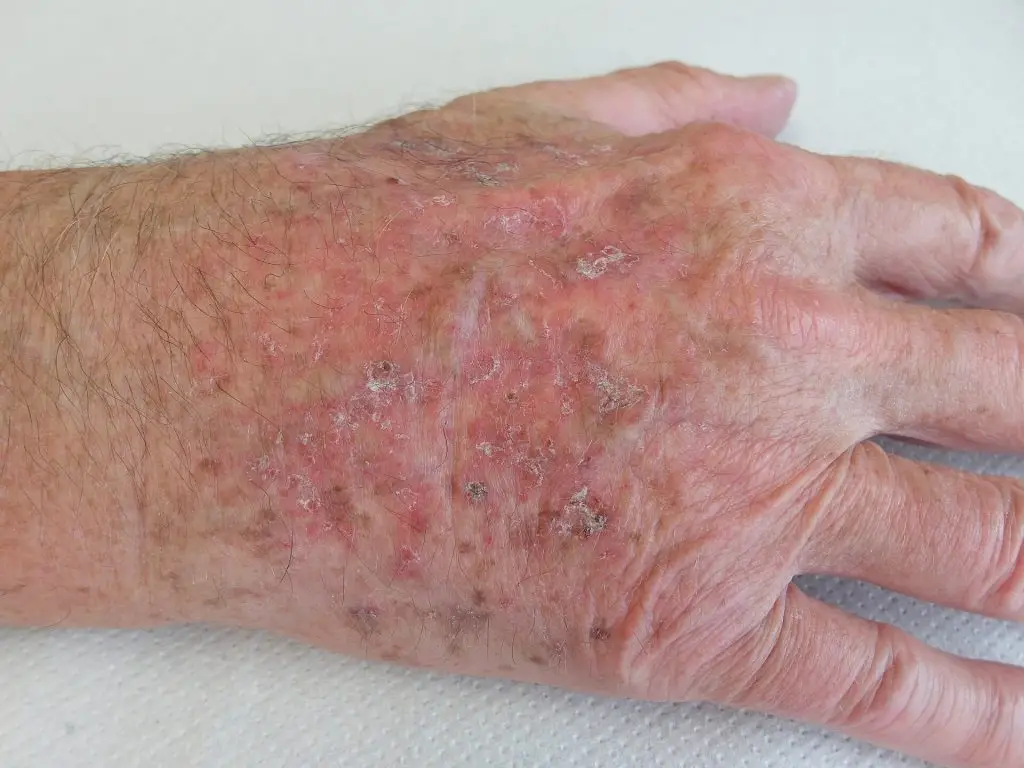
The short answer: yes. Most actinic keratoses (sun damage spots) can be treated with a cream, and creams are often the best choice because they treat the whole area of sun-damaged skin, including spots that aren’t visible yet. Fluorouracil cream (Efudix or Tolak) is the most effective: in a large trial, 3 in 4 people still had at least 75% fewer spots a year later. Solaraze gel is gentler but slower and less effective. Freezing (cryotherapy) is quick for a few individual spots. The right choice depends on how many spots you have, where they are, and how much skin reaction you can cope with.
“Do I need to have these spots frozen, or can I use a cream?” is something I’m asked every week. Here is how the main options compare, when I use each one, and what to expect.
What are actinic keratoses?
Actinic keratoses are rough, scaly patches caused by years of sun exposure. They usually appear on the face, scalp, ears, backs of the hands and forearms, and are common in fair-skinned people over 50. They often feel like sandpaper before you can see them clearly.
They are described as pre-cancerous. Most never become anything more serious, but a small proportion can turn into a skin cancer called squamous cell carcinoma (SCC). The visible spots are also a sign that the surrounding skin, the “field”, is sun-damaged. That is why treating the whole area with a cream often works better than treating spots one by one.
Actinic keratosis creams and treatments compared
| Treatment | How it’s used | How well it works | Skin reaction | Best for |
|---|---|---|---|---|
| Efudix 5% fluorouracil cream |
Once or twice a day for 3 to 4 weeks | The most effective: 9 in 10 had at least 75% fewer spots at 3 months, and 3 in 4 still did a year later | Strong: red, sore, crusting | Widespread sun damage on the face, scalp, hands and arms |
| Tolak 4% fluorouracil cream |
Once a day for 4 weeks | Complete clearance in 54%, versus 4% with a dummy cream | Strong: red, sore, crusting | Face, ears and scalp, where once-daily use is easier |
| Efudix + calcipotriol | Twice a day for just 4 days | 88% fewer spots on the face, versus 26% with 4 days of Efudix alone | Strong but short | Anyone who wants the shortest course |
| Solaraze 3% diclofenac gel |
Twice a day for 60 to 90 days | Complete clearance in about 50% after 90 days, versus 20% with a dummy gel | Mild | Thin, mild spots, or people who can’t cope with a strong reaction |
| Cryotherapy liquid nitrogen |
In clinic, a few seconds per spot | 39% to 83% of spots clear, depending on the freezing time | A blister for a week or two, sometimes a pale mark | A few individual or thicker spots |
Efudix (5% fluorouracil cream)
Efudix has been used for decades and is still the most effective cream. It targets abnormal, fast-dividing sun-damaged cells while largely sparing healthy skin.
Regimen: once or twice a day to the area I mark, usually for three to four weeks.
How well it works: in the largest head-to-head trial, published in the New England Journal of Medicine, 624 patients with multiple actinic keratoses on the head were treated with Efudix, imiquimod cream, photodynamic therapy or ingenol gel. Treatment counted as a success if at least three-quarters of the spots cleared. Three months after treatment, 9 in 10 people using Efudix had reached that, and a year later 3 in 4 still had, compared with about half for imiquimod and 4 in 10 for photodynamic therapy.
The catch: the skin reaction. The treated skin becomes red, sore and crusted for much of the course, and for a week or two afterwards. It shows the cream is working, but many people find it hard going.
Tolak (4% fluorouracil cream)
Tolak contains the same active ingredient as Efudix in a slightly lower strength and a different cream base, licensed for the face, ears and scalp.
Regimen: once a day for four weeks.
How well it works: in the main trial, 54% of patients had complete clearance four weeks after finishing, compared with 4% using a dummy cream, and 81% had at least three-quarters of their spots clear.
Efudix or Tolak? They work in the same way and the reaction is similar. I often choose Tolak for the face and scalp because once-daily use is simpler, and Efudix for the hands and arms, where Tolak isn’t licensed.
Efudix with calcipotriol: the four-day course
Calcipotriol is a vitamin D ointment usually used for psoriasis. Applied together with Efudix, it switches on the skin’s own immune system against the sun-damaged cells, so a much shorter course is needed.
Regimen: Efudix, then the same amount of calcipotriol straight away, twice a day for four days.
How well it works: in a randomised trial of 131 people, four days of the combination reduced the number of actinic keratoses on the face by 88%, compared with 26% for four days of Efudix with Vaseline. The reaction still comes, and often peaks a few days after you stop, but it is over much sooner than with a month of Efudix. Using calcipotriol this way is outside its licence, so I’ll explain this before prescribing it.
If you’ve been prescribed it, my step-by-step guide to using Efudix and calcipotriol includes a one-minute video and a day-by-day picture of the reaction.
Solaraze (3% diclofenac gel)
Solaraze is an anti-inflammatory gel. It works more slowly and less powerfully than fluorouracil, but it is much gentler.
Regimen: twice a day for 60 to 90 days.
How well it works: in controlled trials, about half of patients had complete clearance after 90 days, compared with a fifth using a dummy gel. After 60 days the figure was about a third.
When I use it: for thin, mild actinic keratoses, and for people who can’t take time off for a strong reaction or who reacted badly to fluorouracil before. The trade-off is three months of twice-daily use and a lower chance of full clearance.
Cryotherapy (freezing)
Cryotherapy uses liquid nitrogen to freeze individual spots in clinic. It takes seconds and needs no cream at home.
How well it works: it depends on how long each spot is frozen. In one study, 39% of spots cleared with a freeze under five seconds, 69% with over five seconds and 83% with over twenty seconds. Longer freezes work better but are more likely to leave a pale or white mark.
When I use it: for a handful of individual or thicker spots. It doesn’t treat the surrounding sun-damaged skin, so new spots often appear nearby. For widespread damage, I often freeze the thickest spots and then use a cream for the whole area.
Other options
Imiquimod cream (Aldara or Zyclara) stimulates the immune system and is another field treatment, applied for several weeks. Photodynamic therapy uses a light-activated cream and is done in clinic or with daylight. Both work, but neither did as well as fluorouracil a year after treatment in the head-to-head trial.
Which actinic keratosis treatment is best for me?
- Lots of spots, or a patch of rough skin: a fluorouracil cream (Efudix or Tolak), or the four-day combination if you’d prefer a short course.
- A few individual spots: cryotherapy.
- Thin, mild spots and you want to avoid a strong reaction: Solaraze.
- Thick spots on a sun-damaged background: freezing the thick ones plus a cream for the field.
When a cream isn’t enough
Some spots need a different approach. A spot that is thick, tender, bleeding, growing quickly or not clearing after treatment may be a squamous cell carcinoma rather than an actinic keratosis. These need a biopsy or removal, not a cream. You can read more on my squamous cell carcinoma treatment page, and about how the skin cancers differ in BCC vs SCC.
Frequently asked questions
Is Efudix or Solaraze better for actinic keratosis?
Efudix is more effective, but the reaction is much stronger. Solaraze is gentler and suits thin, mild spots, but it takes up to three months and clears fewer spots.
Will the spots come back?
Treated spots usually stay clear, but new ones can appear in sun-damaged skin over the years. Many people need a course of treatment every few years. Daily sunscreen reduces the number of new spots.
Can I wear make-up or sunscreen during treatment?
Sun protection is essential during and after treatment, as fluorouracil makes the skin more sensitive to sunlight. Apply sunscreen once the cream has soaked in. Make-up is best avoided on broken or crusted skin.
Are these creams available without a prescription?
No. Efudix, Tolak and Solaraze are prescription medicines, and the spots should be examined first to make sure they are actinic keratoses and not a skin cancer.
Next steps
If you have rough, scaly patches on sun-exposed skin, book a consultation at The Ü Clinic in Sevenoaks or Oxted. I’ll examine your skin, check for anything that needs a biopsy, and recommend the treatment that best fits your skin and your diary.
Sources
- Jansen MHE, Kessels JPHM, Nelemans PJ, et al. Randomized trial of four treatment approaches for actinic keratosis. New England Journal of Medicine 2019;380:935–46.
- Tolak 40 mg/g cream: Summary of Product Characteristics. Electronic Medicines Compendium.
- Cunningham TJ, Tabacchi M, Eliane JP, et al. Randomized trial of calcipotriol combined with 5-fluorouracil for skin cancer precursor immunotherapy. Journal of Clinical Investigation 2017;127:106–16.
- Diclofenac sodium 3% in hyaluronic acid 2.5% gel for actinic keratoses: review of controlled trials (PubMed 12627996).
- Thai KE, Fergin P, Freeman M, et al. A prospective study of the use of cryosurgery for the treatment of actinic keratoses. International Journal of Dermatology 2004;43:687–92.
- de Berker D, McGregor JM, Mohd Mustapa MF, et al. British Association of Dermatologists’ guidelines for the care of patients with actinic keratosis 2017. British Journal of Dermatology 2017;176:20–43.
Header image: Dr Thomas Brinkmeier, WIKIDERM, CC BY 4.0, via Wikimedia Commons. Not Mr Kumar’s patient.

Mr Siva Kumar Veeramani
MBBS, BMed.Sci (Hons), MRCS, MBA, FRCS (Plast.). Consultant Plastic, Reconstructive & Cosmetic Surgeon practising across London, Kent, Surrey and Sussex. GMC 6114710.
About Mr Siva Kumar →