How do I check my lymph nodes after melanoma or SCC?
A step-by-step guide to checking the lymph nodes in your armpit, groin and neck after melanoma or squamous cell carcinoma, and what to look out for.

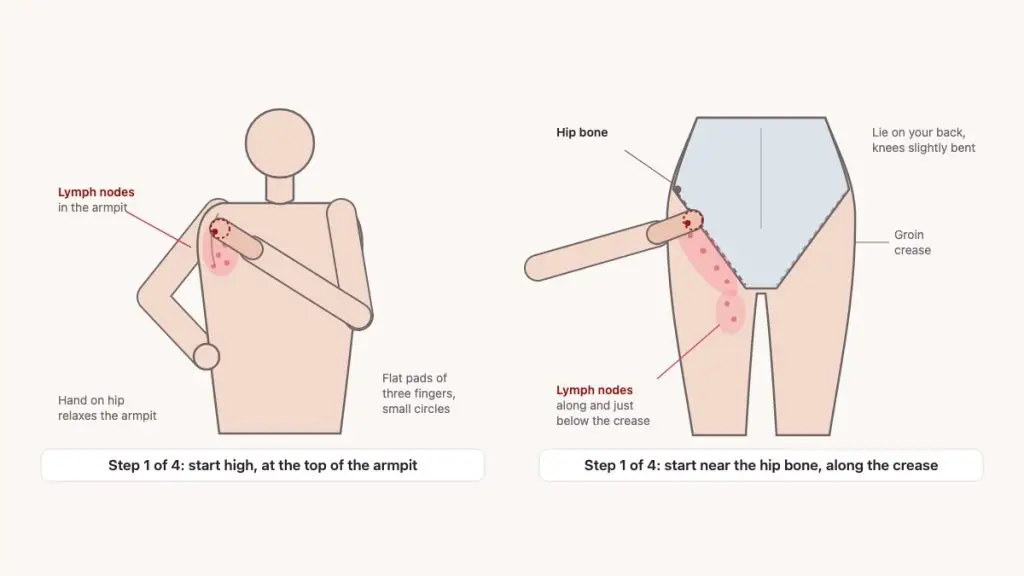
The short answer: once a month, gently feel the lymph nodes nearest to where your skin cancer was, usually in your neck, armpit or groin, and look at the skin around your scar. You are feeling for a new lump that is firm, getting bigger, or still there after three weeks. If you find one, contact your skin cancer team straight away. Don’t wait for your next appointment.
After treatment for melanoma or squamous cell carcinoma (SCC), many people tell me the waiting between appointments is the hardest part. Checking yourself regularly is one of the most useful things you can do in that time. It takes about five minutes, and it means that if something does change, it is found early.
Most lumps people find turn out to be normal lymph nodes or something harmless. The aim is not to make you anxious, but to help you get to know what is normal for you, so you notice if anything changes.
Why check your lymph nodes?
Lymph nodes are small, bean-shaped glands that filter fluid from the skin and the rest of the body. If melanoma or SCC spreads, it usually spreads first to the lymph nodes nearest the original skin cancer. A new lump in those nodes can be the first sign, often long before you feel unwell.
Finding a change early usually means it can be treated earlier. Your follow-up appointments and any scans are important, but they happen months apart. Your own checks fill the gaps in between.
Which lymph nodes should I check?
It depends on where your skin cancer was. As a rule:
- Head, face, scalp or neck: check your neck, in front of and behind your ears, under your jaw and chin, and just above your collarbones.
- Arm, hand, chest or upper back: check the armpit on the same side. For the upper back, check both armpits and your neck.
- Leg, foot, lower tummy, lower back or buttock: check the groin on the same side. For the foot or calf, also feel behind the knee.
Skin on the back and the middle of the body can drain to either side, so your team may ask you to check both armpits or both groins. If you are not sure which areas to check, ask at your next appointment. I always show my patients where to feel.
It helps to check both sides every time, even if your skin cancer was only on one side. The other side shows you what is normal for you.
How often, and when?
- Once a month is enough. Pick the same date each month, so it becomes a habit.
- Do it somewhere warm and relaxed. In the bath or shower, or lying on your bed, works well. Soapy skin makes it easier to feel.
- Use the flat pads of your fingers, not your fingertips, and press gently but firmly.
- Move your fingers in small circles, so the skin moves over the tissue underneath, then move on to the next spot.
How to check your armpit
- Get comfortable. Sit or stand. To check your right armpit, use your left hand.
- Relax the armpit. Lift your right arm slightly away from your side, then rest your right hand on your hip or let the arm hang loosely. A relaxed armpit is much easier to examine than a stretched one.
- Start high. Place the flat pads of your three middle fingers right up into the top of the armpit and press gently in small circles.
- Work around the armpit. Move down the inner side against your ribs, then feel along the front edge (the chest muscle) and the back edge (the muscle behind the armpit).
- Repeat on the other side, using your right hand for your left armpit.
How to check your groin
- Lie down on your back, with your knees slightly bent and relaxed. Lying down makes the groin softer and easier to feel.
- Find the crease where the top of your thigh meets your tummy.
- Feel along the crease, from the bony point of your hip towards the middle, using the flat pads of your fingers and small circles.
- Feel just below the crease too, on the top of the inner thigh, about a hand’s width down. Many groin nodes sit here.
- Repeat on the other side.
How to check your neck
If your skin cancer was on your head or neck, sit or stand with your chin slightly down and your neck relaxed. Using both hands, feel in front of and behind your ears, along and under your jaw, under your chin, down both sides of your neck, and in the hollows just above your collarbones.
Don’t forget your scar
As well as your lymph nodes, look at and feel the skin in and around your scar, and the skin between the scar and the nearest lymph nodes. Tell your team about any new bump, lump or spot there, whether it is pink, red, dark blue-black or skin-coloured. Occasionally melanoma can come back as small lumps in this area.
While you are checking, it is a good time to look over the rest of your skin for any new or changing moles. A mirror, or a partner, helps with your back.
What is normal, and what should I look out for?
Usually normal:
- small, soft or rubbery nodes, about the size of a pea or smaller, that move slightly under your fingers
- nodes that are tender and swell when you have a cold, sore throat or infection nearby, then go back down within two to three weeks
- the same lumps that have felt the same for months
Contact your team if you notice:
- a new lump that is still there after three weeks
- a lump that is firm or hard, or feels fixed rather than moving freely
- a lump that is getting bigger, or is larger than about a centimetre (the width of a fingernail)
- any new lump or spot in or around your scar
A lump that doesn’t hurt is not necessarily reassuring. Lymph nodes affected by skin cancer are often painless.
Also tell your team about any symptoms that are new and don’t settle, such as unexplained weight loss, a cough that won’t go away, new headaches, or new aches in your bones. These are usually caused by something else, but they are worth mentioning.
If you have had lymph node surgery
If you have had a sentinel lymph node biopsy or a lymph node operation, the area can feel firmer or lumpy for months because of scar tissue. That is normal. Get to know how it feels in the first few weeks, then look out for anything that changes. If you are not sure, it is always fine to ask.
Some people are also offered regular ultrasound scans of their lymph nodes. If that applies to you, your team will explain how often. Your own monthly checks are still worth doing between scans.
Quick questions
Can I check too often?
Checking every day can make normal nodes seem to change, and it can make you more anxious. Once a month is the right balance. If you have found something, check it again after a week or two, but don’t keep prodding it every day.
I’ve found a lump. What should I do?
Don’t panic. Most lumps are harmless. Make a note of where it is and roughly how big it feels, then contact your skin cancer team or clinical nurse specialist. They will usually arrange to see you or organise an ultrasound scan. If you are under my care, call the team on 020 3026 9695.
Can someone else check for me?
Yes. A partner or family member can help, especially with the back of your neck and your scar. It helps if they come to an appointment so we can show them what to feel for.
How long should I keep checking?
Your team will tell you how long your follow-up will last. Most people keep checking their nodes and their skin for life, because it takes only a few minutes a month.
Next steps
If you have been treated for melanoma or SCC and are worried about a lump, please don’t wait. Contact your skin cancer team, or book an appointment with me at The Ü Clinic in Sevenoaks or Oxted. I am happy to see you even if you were treated elsewhere.

Mr Siva Kumar Veeramani
MBBS, BMed.Sci (Hons), MRCS, MBA, FRCS (Plast.). Consultant Plastic, Reconstructive & Cosmetic Surgeon practising across London, Kent, Surrey and Sussex. GMC 6114710.
About Mr Siva Kumar →