Immunotherapy for melanoma: how does it work, and is it right for me?
What immunotherapy for melanoma is, how it works, who is offered it before or after surgery, what treatment is like, side effects to watch for, and the latest research.

The short answer: immunotherapy for melanoma is a treatment that helps your own immune system recognise and attack melanoma cells. It’s given through a drip, usually every three to six weeks. It’s offered after surgery for many stage 2B, 2C and 3 melanomas to lower the chance of the melanoma coming back, before surgery for some stage 3 melanomas, and as the main treatment for melanoma that has spread. It has transformed the outlook for advanced melanoma. It can cause side effects anywhere in the body, so knowing what to look out for, and reporting symptoms early, really matters.
One of the first questions people ask me after a melanoma diagnosis, often before I’ve finished explaining their operation, is “Will I need immunotherapy?” It’s a word most people have heard, and it can sound frightening. I’m a plastic surgeon rather than an oncologist, so I don’t prescribe immunotherapy myself. But I work alongside the oncologists who do, in the specialist skin cancer team that discusses every patient, and I see how it fits into a person’s treatment from the very start. In this article I explain in plain language what immunotherapy is, how it works, who it’s for, what it’s like to have, and what the latest research shows.
What is immunotherapy for melanoma?
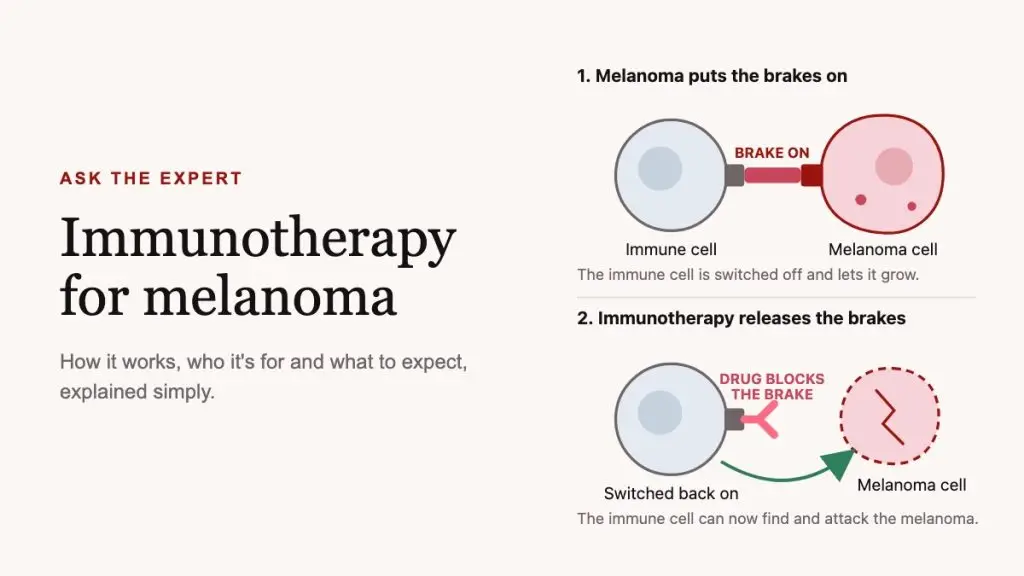
Your immune system is constantly checking your body for things that shouldn’t be there, including cancer cells. Immune cells called T cells can recognise melanoma cells and destroy them. But melanoma is clever: it can switch off the immune cells that come to attack it.
The immunotherapy used for melanoma is a group of medicines called immune checkpoint inhibitors. They stop melanoma switching off your immune cells, so your immune system can do its job again. The main ones used in the UK are:
- pembrolizumab and nivolumab, which block a “brake” on immune cells called PD-1
- ipilimumab, which blocks a different brake called CTLA-4, and is usually given together with nivolumab
- relatlimab, which blocks a third brake called LAG-3, and is given combined with nivolumab
Immunotherapy isn’t chemotherapy. It doesn’t attack cancer cells directly, and it doesn’t usually cause hair loss or the sickness people associate with chemotherapy. It works through your own immune system, which is why its side effects are different too.
How does immunotherapy work?
The easiest way to understand it is to think of brakes on a car. Immune cells have built-in brakes, which normally stop them attacking your own healthy tissue. Melanoma cells learn to press those brakes, so the immune cells stop attacking them. Immunotherapy blocks the brake, releasing the immune cells to find and attack the melanoma.
“I often describe immunotherapy as taking the handbrake off your own immune system. The medicine doesn’t kill the melanoma itself. It lets your body do it.”
Mr Siva Kumar, consultant plastic surgeon
Who is offered immunotherapy for melanoma?
Whether immunotherapy is offered, and when, depends mainly on the stage of your melanoma. The stage is worked out from how thick the melanoma was, whether it had broken the skin surface (ulceration), and whether it has spread to the lymph nodes or elsewhere. That’s why the results of your surgery, including any sentinel lymph node biopsy, are so important.
1. Immunotherapy after surgery (adjuvant treatment)
After a melanoma has been completely removed, there’s still a chance that a few melanoma cells, too small to see on any scan, have been left behind. Adjuvant immunotherapy aims to mop them up and lower the chance of the melanoma coming back.
- Stage 3 melanoma (spread to the lymph nodes): pembrolizumab or nivolumab, usually for up to a year, are recommended by NICE. In the main trial of pembrolizumab, it reduced the risk of the melanoma coming back by around 40% compared with placebo.
- Stage 2B and 2C melanoma (thick melanomas without spread to the lymph nodes): NICE recommended adjuvant pembrolizumab in 2022, after a trial showed it reduced the chance of the melanoma coming back by around a third.
- If your melanoma has a change in a gene called BRAF, targeted tablets are another option after surgery for stage 3 melanoma, and your oncologist will talk through which suits you best.
2. Immunotherapy before surgery (neoadjuvant treatment)
This is one of the most exciting recent changes. For some people with stage 3 melanoma that can be seen or felt in the lymph nodes or skin and can be removed with an operation, giving immunotherapy before surgery works better than giving it only afterwards. The theory is that while the melanoma is still there, the immune system has more to recognise and learn from.
In a large American trial published in 2023, people who had three doses of pembrolizumab before surgery, then more afterwards, were much more likely to be free of melanoma at two years (72%) than those who had all their treatment after surgery (49%). A European trial in 2024 found similar benefits with a combination of nivolumab and ipilimumab. In April 2026, NHS England approved immunotherapy before and after surgery for eligible patients with stage 3 melanoma, following earlier approval in Scotland, Wales and Northern Ireland.
This changes the order of treatment, so it matters that your surgeon and oncologist plan it together from the start.
3. Immunotherapy for advanced melanoma
For melanoma that has spread and can’t be removed with surgery (some stage 3 and stage 4 melanoma), immunotherapy is the main treatment. It may be a single drug, or a combination such as nivolumab with ipilimumab, or nivolumab with relatlimab. It’s usually given for up to two years, or for as long as it keeps working and side effects allow.
“When I started training, the outlook for melanoma that had spread was measured in months. Immunotherapy has changed that completely. I now see people living full lives many years after a stage 4 diagnosis.”
Mr Siva Kumar
How well does immunotherapy work for melanoma?
The long-term results for advanced melanoma are remarkable. The landmark trial of nivolumab and ipilimumab, called CheckMate 067, published its final 10-year results in the New England Journal of Medicine in 2024:
- with the combination, around half of people (52%) had not died from melanoma after 10 years
- before immunotherapy, most people with stage 4 melanoma lived less than a year
- among people whose melanoma hadn’t grown at three years, more than 9 in 10 had not died from melanoma by 10 years
Immunotherapy doesn’t work for everyone, and nobody can predict for certain who will respond. But for many people, the response is long-lasting, even after treatment stops.
What is it like to have immunotherapy?
- Where: as an outpatient in a hospital cancer day unit. You go home the same day.
- How: through a drip into a vein, taking 30 to 90 minutes.
- How often: every three, four or six weeks, depending on the drug and dose.
- Checks: blood tests before each treatment, to check your liver, kidneys, thyroid and other hormones, and regular scans to see how the melanoma is responding.
- An alert card: you’ll be given a card to carry, explaining that you’re having immunotherapy, and a 24-hour helpline number to call if you feel unwell.
Most people carry on with much of their normal life during treatment, including work, although tiredness is common.
What are the side effects of immunotherapy?
Because immunotherapy releases the brakes on your immune system, the immune system can sometimes attack healthy parts of the body as well as the melanoma. This causes inflammation, which can affect almost any organ. Doctors call these immune-related side effects.
Some things worth knowing:
- Most side effects are mild, such as tiredness, an itchy rash or mild diarrhoea, and settle with simple treatment.
- Some can be serious. After surgery, around 1 in 7 people having a single drug has a serious side effect. With combination treatment for advanced melanoma, more than half do.
- They can happen at any time, including in the first few weeks, months into treatment, and occasionally after treatment has finished.
- Hormone glands can be affected permanently, especially the thyroid and the pituitary gland in the brain. This is usually easily managed with a daily hormone tablet, but it may be lifelong.
- Most side effects are treatable, usually with steroids, especially when they’re caught early.
The most important thing is not to “soldier on”. If you develop diarrhoea, a new cough, breathlessness, a bad headache, yellow skin, or simply feel unwell, call your 24-hour oncology helpline straight away, even if it seems minor.
“The people who do best with immunotherapy side effects are the ones who ring early. A phone call about a bit of diarrhoea is never a waste of anyone’s time.”
Mr Siva Kumar
Is immunotherapy the right choice for me?
That’s a decision you make with your oncologist, and it’s very personal, especially after surgery for stage 2B, 2C or early stage 3 melanoma. Many people in this group would never have had their melanoma come back, even without immunotherapy, so some people take on the risk of side effects without benefiting. Others will have their melanoma prevented from coming back. Your oncologist can give you an estimate of your own risk of recurrence, and how much immunotherapy is likely to lower it, to help you decide.
Questions worth asking:
- What is my chance of the melanoma coming back without treatment, and with it?
- Which drug would I have, how often, and for how long?
- Would treatment before surgery be an option for me?
- Is my melanoma BRAF-positive, and would targeted tablets be an alternative?
- What side effects are most likely, and who do I call at night?
- Are there any clinical trials I could join?
Where does surgery fit in?
Surgery is still the foundation of melanoma treatment. Removing the melanoma with a wide local excision, and a sentinel lymph node biopsy where it’s recommended, cures many people and provides the information needed to decide whether immunotherapy will help. If you’re offered immunotherapy before surgery, your operation is planned around it, and your surgeon and oncologist work closely together.
After treatment, regular follow-up, skin checks and checking your own lymph nodes remain just as important.
What’s new in melanoma immunotherapy?
- Personalised mRNA vaccines. A vaccine made specifically for each person’s melanoma, given alongside pembrolizumab after surgery, reduced the risk of melanoma coming back or death by around 40% compared with pembrolizumab alone in a large international trial reported in 2026. It isn’t yet routinely available in the UK, but NHS patients have been able to join trials through the NHS Cancer Vaccine Launch Pad.
- Cell therapy. Treatments that grow a person’s own tumour-fighting immune cells in a laboratory and give them back, known as TIL therapy, are approved in the US for some advanced melanomas and are being studied in the UK.
- New combinations and shorter treatment, to get the same benefit with fewer side effects.
Quick questions
Is immunotherapy the same as chemotherapy?
No. Chemotherapy attacks dividing cells directly. Immunotherapy works by switching your own immune system back on against the melanoma. The side effects are different, and hair loss is uncommon.
How long does immunotherapy take to work?
For advanced melanoma, it can take two to three months before scans show a response, and occasionally the melanoma looks bigger at first before shrinking.
Can I work during immunotherapy?
Many people do, sometimes with adjustments. Tiredness is the most common side effect, so it helps to have some flexibility.
Can I have vaccines during immunotherapy?
Inactivated vaccines, such as the flu jab, are usually recommended. Live vaccines may need to be avoided. Check with your oncology team first.
If I get side effects, does it mean it’s working?
Some studies suggest people who develop side effects may respond better, but many people respond well with no side effects at all. Side effects aren’t a sign you need to put up with.
Can I have immunotherapy privately?
Yes, and it’s usually covered by private medical insurance, though check your policy’s cancer cover. NICE-recommended immunotherapy is also available on the NHS.
Can I drink alcohol or go in the sun?
Moderate alcohol is usually fine, but it can make liver tests harder to interpret, so ask your team. Protect your skin from the sun, as you would after any melanoma.
Where can I find support?
A melanoma diagnosis, and decisions about immunotherapy, can feel overwhelming. The UK charity Melanoma Focus runs a free, confidential Melanoma Helpline staffed by specialist skin cancer nurses on 0808 801 0777 (1pm to 2pm and 7pm to 9pm, Monday to Friday, and 7pm to 9pm on Sundays), and publishes a detailed patient guide to melanoma stages and treatment. Macmillan Cancer Support (0808 808 00 00) can also help with practical and emotional support.
Next steps
If you’ve been diagnosed with melanoma and want to understand your treatment options, from surgery to whether immunotherapy might be offered, read more on my melanoma treatment page or book a consultation at The Ü Clinic in Sevenoaks or Oxted. You may also find my article on vitamin D after melanoma helpful.
Sources
- Wolchok JD, et al. Final, 10-year outcomes with nivolumab plus ipilimumab in advanced melanoma. New England Journal of Medicine 2025;392:11–22. PubMed 39282897
- Patel SP, et al. Neoadjuvant–adjuvant or adjuvant-only pembrolizumab in advanced melanoma (SWOG S1801). New England Journal of Medicine 2023;388:813–23.
- Blank CU, et al. Neoadjuvant nivolumab and ipilimumab in resectable stage III melanoma (NADINA). New England Journal of Medicine 2024.
- Eggermont AMM, et al. Adjuvant pembrolizumab versus placebo in resected stage III melanoma (KEYNOTE-054). New England Journal of Medicine 2018;378:1789–801.
- Luke JJ, et al. Pembrolizumab versus placebo as adjuvant therapy in completely resected stage IIB or IIC melanoma (KEYNOTE-716). Lancet 2022;399:1718–29.
- NICE. Pembrolizumab for adjuvant treatment of resected stage 2B or 2C melanoma (TA837). nice.org.uk
- NHS England. Clinical commissioning policy: neo-adjuvant followed by adjuvant pembrolizumab for stage III macroscopic resectable melanoma. 2026. england.nhs.uk
- Melanoma Focus. Neoadjuvant therapy approved by NHS England, and Melanoma Helpline. melanomafocus.org
- Merck and Moderna. Phase 3 INTerpath-001 results for intismeran autogene plus pembrolizumab, ESMO 2026. ajmc.com

Mr Siva Kumar Veeramani
MBBS, BMed.Sci (Hons), MRCS, MBA, FRCS (Plast.). Consultant Plastic, Reconstructive & Cosmetic Surgeon practising across London, Kent, Surrey and Sussex. GMC 6114710.
About Mr Siva Kumar →